

"If you make it into the top six, we'll erect a monument to you in front of the Vasil Levski Stadium." This line dates back to the summer of 1986 and sounds like part of the folklore surrounding a great success. Only, the story is true. Nikolay Dankinov recounts it 30 years later to the European Volleyball Confederation. The Bulgarian juniors were returning from a preparatory tournament in Hungary, where, according to him, they were "beaten by everyone" and finished second to last. Faith in the team was apparently not particularly strong, and the federation jokingly promised them a monument if they managed to get into the top six at the upcoming European Championship in Pazardzhik.
They were not satisfied with the top six. They became first.
I was there – at the European Championship in Pazardzhik, as part of the staff of that team. Four decades later, I returned to the yellowed issues of "Naroden Sport" and "Start," to old photographs and to the people with whom we experienced those days. Some details have been blurred by time, others have surprisingly remained. And while preparing the material, I stumbled upon something I didn't expect at all.
There is no monument. They are also missing from history.
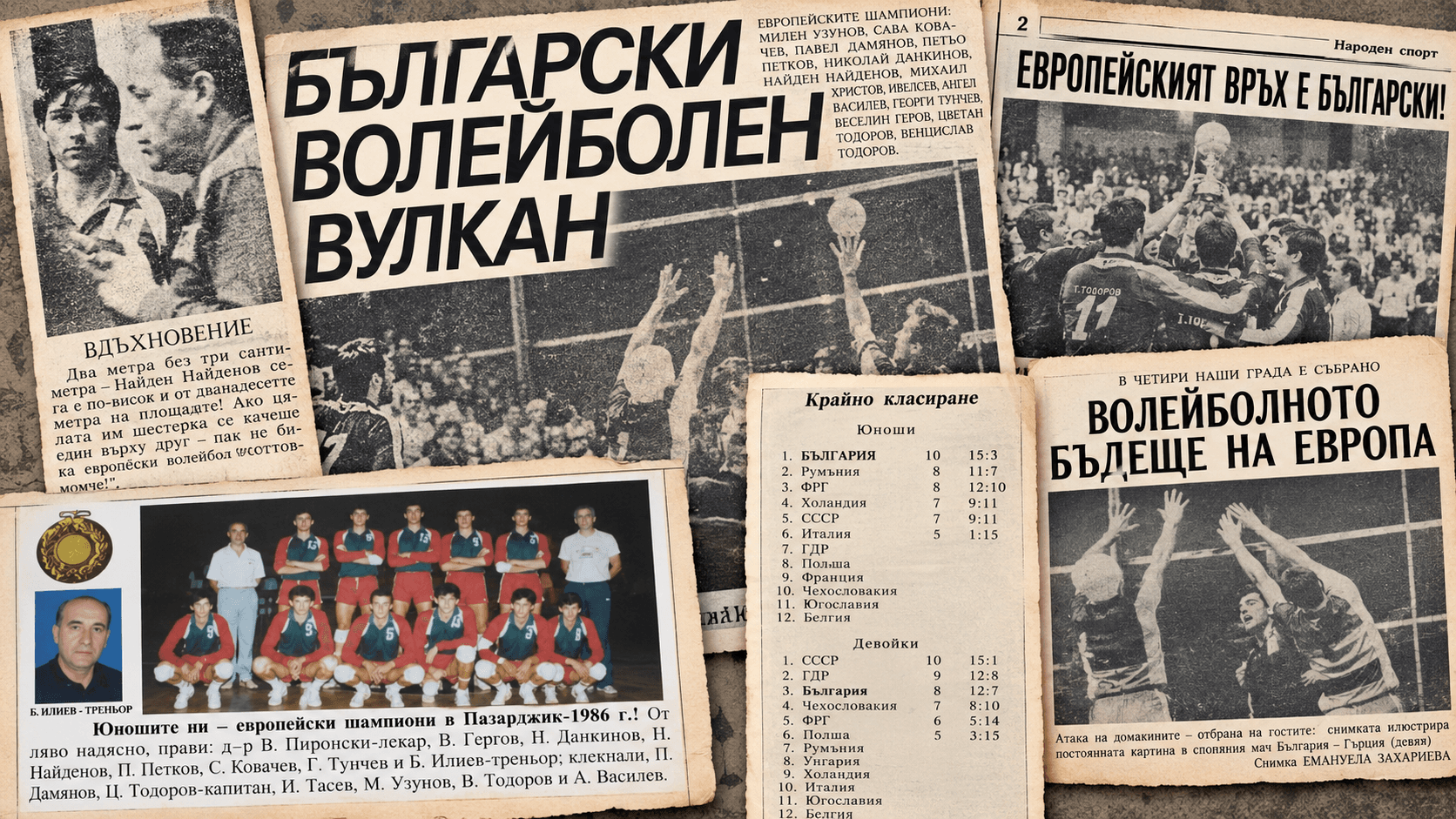
Pazardzhik 1986 is missing from the official historical chronicle of the Bulgarian Volleyball Federation. For 1986, it notes the bronze medal of the men's national team from the World Championship in Paris. In subsequent periods, the world title of the youth team in Cairo in 1991 is present, and a number of more recent successes of the national youth formations are described. But the first and so far only European title won by a Bulgarian national team in the men's category is missing. This is precisely what makes the omission so strange. It's not just another medal missed from the long history of Bulgarian volleyball. The team that did something in August 1986 that Bulgaria had never achieved before is missing.
And here the old joke about the monument begins to sound a little different.
Nine championships under the sign of the USSR. At the tenth – Bulgaria.
Today's reader can hardly grasp the significance of that gold medal just from the final standings. The European Championship in Pazardzhik was the tenth in this age category. In the previous nine editions, the champion was the same – the USSR. Bulgaria had reached second place four times, but never the top. The last silver was won two years earlier in Clermont-Ferrand, France, by the team whose ranks included Lyubomir Ganev and Dimo Tonev, and whose coach was the ubiquitous Bogdan Kyuchukov.
"For 20 years since the championship existed, Europe had one champion. One name, one authority, one magnificent school, one example, one peak – Soviet volleyball with its boundless possibilities," wrote Kliment Velichkov in "Start" after the tournament.
And he adds a sentence that best shows how the Bulgarian success was perceived then: "There is no higher honor than to take a step further than your idol and teacher."
The championship began on August 17. Bulgaria was in a preliminary group with Romania, France, and Czechoslovakia. The French were defeated 3:0 (15:11, 15:5, 15:6), against Czechoslovakia it went to five sets, and the match with Romania showed something else that would later prove important. After the first two sets, won relatively easily, the Bulgarians allowed their opponent to pull away in the third. Then came the reaction, and "Naroden Sport" specifically noted the successful substitutions by Brunko Iliev and the help of Ivan Tasev, Veselin Gerov, Pavel Damyanov, and Petyo Petkov.
The victories continued in the decisive phase, but the championship was by no means smooth sailing. Fatigue and tension accumulated, and one of the reports in "Naroden Sport" received a title that said enough: "Whoever endures...". Against Italy, the Bulgarians won 3:0. However, the newspaper did not get carried away by the result and noted that this was not the team's best match. More importantly, our players did not get caught up in the opponent's tempo and outplayed them at the net. Then came the Netherlands. The Dutch had already shown why they should be approached with great caution – they had defeated the USSR. "Naroden Sport" was impressed by their intelligent play, finesse, lightness, and freedom with which they moved on the court. Bulgaria also passed this test, and the reporter summarized the tension in one short sentence: "They had to win – they won."
Thirty years later, Dankinov recalled to CEV that the Netherlands was one of the most serious opponents. Just a few months earlier, the Dutch were among the teams that defeated Bulgaria at the ill-fated tournament in Hungary. In Pazardzhik, the roles were now different. The next day came the most dramatic match in the final six. Bulgaria defeated West Germany 3:2 (5:15, 15:12, 15:3, 9:15, 15:9). After a tough start, our team turned the match around, and in the fifth set reached 15:9. The victory guaranteed the European title even before the last day of the championship.
However, one match remained – against the USSR. For our team, it could not change anything in the battle for gold, but for the Soviet team, the stakes were huge – with a win, they would finish second, with a loss, they would remain fourth. However, the Bulgarians had no intention of simply playing out the championship. As captain Tsvetan Todorov put it, they went out with "a liter of blood and a meter of skin." In front of the ecstatic crowd in Pazardzhik, they defeated the USSR 3:0 and finished the tournament exactly as they had played it – undefeated.
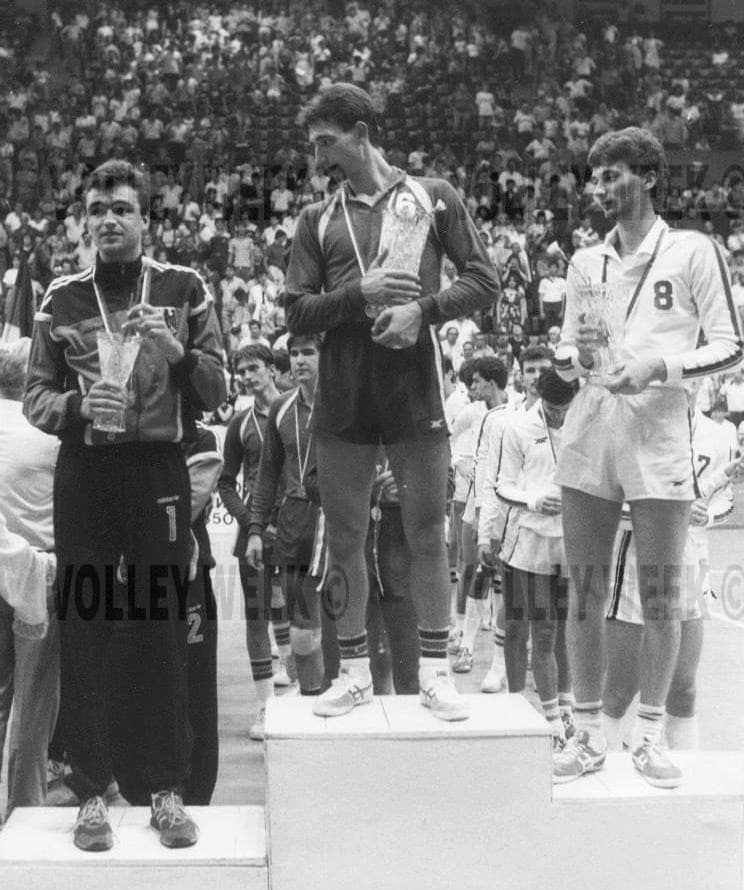
And "Naroden Sport" came out with the big headline "The European Peak is Bulgarian!". Below the photo remained another phrase from those days: "Seven days – seven victories! For the first time, Bulgarian juniors are champions!"
Brunko and his team
The more one reads the old reports, the clearer it becomes that this title can hardly be explained by a single hero. In almost every difficult moment, a different name emerges.
The inclusion of Petyo Petkov is particularly indicative. "Naroden Sport" describes him as an "example of courage and an impeccable, bright presence" and notes his points from serves and his work on the block. At other times, Tasev, Gergov, and Damyanov helped. The bench was not just a backdrop to the six players on the court.
That this is not a journalistic generalization after a won title is best seen from the words of captain Tsvetan Todorov, spoken in an interview for "Naroden Sport." When someone is substituted, they don't get angry. And the one who comes in instead does it, as Todorov says, "completely unreservedly."
The same Tsvetan also leaves perhaps the most accurate portrait of Brunko Iliev: "Our coach Brunko Iliev also doesn't mince words, not that he can't, but whatever is in his soul, that's what's on his lips."
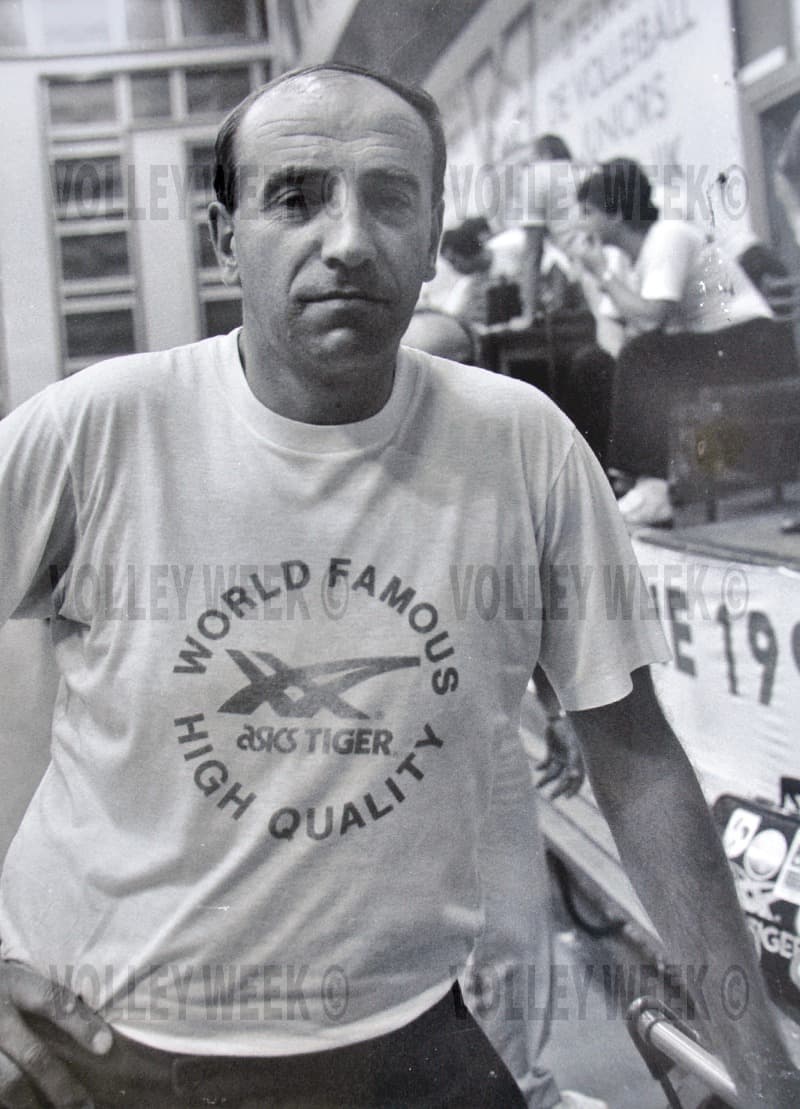
In one of the preserved black-and-white photos, Brunko is in the hall in Pazardzhik. White jersey, serious look. A shot without a cup, without medals, and without celebration. But in fact, the team that will change history in a few days is built around this very person.
The captain is only 19 years old. Tsvetan Todorov was born in Tolbuhin, present-day Dobrich, went through the Dobrudzha academy, and by the time of the European Championship, he was already a player for CSKA "Septemvriysko Zname". When asked about the feeling after the title, he doesn't talk much about himself. The meaning of his words is different - everyone is a champion, but part of a champion team.
Off the court, these are 18-19 year old boys. They listen to music, almost everyone has a cassette player, their tastes range from hard rock to country. Many are excellent students. In old texts, it's hard to find star-mania.
And right here, the archive unlocked a memory of my own. Before every match in the locker room, I would play the same song for the boys. It had become something of a good luck charm for the team. Forty years later, I remember the ritual, but I can't remember what the song was. Somewhere among those cassettes, this small answer from Pazardzhik 1986 is probably hidden.
Not just character. There was a lot of volleyball too.
Over time, great victories easily turn into stories of spirit, character, and audience. However, the archives show something else - the Bulgarians were a very well-prepared volleyball team.
"Technically, we were also good," writes "Naroden Sport," and then begins to analyze individual elements and players. Tsvetan Todorov is sharp in attack, but he sees the empty court and doesn't use force at all costs. Georgi Tunchev is "elegant." Sava Kovachev is the man for combination play. Pavel Damyanov "jumps a full meter." And for Nikolay Dankinov, a phrase was found that 40 years later needs no editing: "N. Dankinov not only outplays the block, but often flirts with it."
The analyses speak of reception, defense, blocking, combination play, and the need for a volleyball player to be increasingly versatile. "Start" even notes "the step taken away from the fascination with gigantism."
The recommendation for the serve sounds particularly interesting: "The essence is that we have volleyball players who, in the future, before leaving the hall, must have counted 300 hits from the service zone."
You read it in 2026 and the language is old, but the problem sounds quite familiar in light of the past home European Championship last month.
Ivan Shahov, who had been working with young national teams for nine years in the 80s, also does not believe that the champions are necessarily more individually talented than previous generations. According to him, the difference lies in comprehensive training and "complete compatibility of characters." Kiril Nikolov from the then leadership of the federation highlights something else - the coaches managed to bring the team to its best form exactly when it was needed. Months earlier, almost everyone had beaten them in Hungary. In August, they were already the best in Europe.
"The destroyer of walls and blocks"
And when the old pages reach the individual members of this team, one name constantly comes to the fore. Nayden Naydenov. From Pazardzhik, 19 years old, 1.97 m tall - or, as "Start" prefers to present him, "two meters minus three centimeters." Kliment Velichkov dedicates a special box to him with the title "Inspiration" and calls him "the destroyer of walls and blocks, built and cemented north of the Rhine and south of the Tiber." Behind the impressive phrase, however, lies much more than a strong attack. In technical evaluations, Nayden is also highlighted for his reception. At the end of the championship comes the official recognition - he is chosen as the best attacker.
Velichkov wrote even then that whenever we look back at this new peak of Bulgarian volleyball, Nayden's name should be associated with it.
Twenty-six years later, the same Nayden Naydenov is now the head coach of the men's national team. Bulgaria reached the semi-finals of the Olympic Games in London in 2012 and finished fourth.
From the court in Pazardzhik to the Olympic semi-final in London - a career that connects two different generations of Bulgarian volleyball.
"Bulgarian Volleyball Volcano"
"Naroden Sport" follows the championship day after day. "Start" has another advantage - the time to look a little further and try to understand what actually happened. Kliment Velichkov titles his article "Bulgarian Volleyball Volcano."
"We talked for a long time about the twilight over our volleyball. Our young volleyball players were faster - a day before the European Youth Championship ended, they became champions of the Old Continent."
This is important. We are not writing it 40 years later, trying to give additional weight to an old title. This is how it looked back in August 1986.
Then, in volleyball circles, it was said that our time had passed, that Bulgaria once had great volleyball, but now it is "sick." Velichkov uses an even stronger image – "our cart creaks behind foreign express trains."
And that's when Pazardzhik comes. "The Tenth European Championship and our victory in it is not an ordinary phenomenon. This is a turning point, a turbulent volleyball time...", writes the author.
Around Bulgaria, "dozens of volcanoes" are already awakening. Only, in young European volleyball, "our, the Bulgarian volcano" erupts first.
And opposite is already the future
Four decades later, the rosters of the other teams give another idea of the level of this championship.
In the Netherlands is 19-year-old Ron Zwerver – "Ron Zwerfer" in the Bulgarian press of the time. "Naroden Sport" dedicates a separate portrait to him and highlights his serve, diagonal attack, and technical qualities. Ten years later, that boy from the Pazardzhik championship would become an Olympic champion in Atlanta.
Among the Italians is also the legend Lorenzo Bernardi. Riccardo Michieletto is also there, with whom my own volleyball path would cross again after a quarter of a century. In 2011, I took my son to a volleyball camp in Trento and there I met Michieletto Sr. again. At that time, it was just a nice meeting with a person I remembered from a distant European championship. Another 14 years passed. In 2025, I was in the Philippines for the World Championship. In the final, Bulgaria once again had Italy on the other side of the net. The Italians won the world title, and Alessandro Michieletto – Riccardo's son – was chosen as the MVP of the championship.
In 1986, I watched the father against our country in Pazardzhik. In 2025, I watched the son in a World Championship final against Bulgaria.
Sometimes volleyball itself makes connections that no one could have suspected four decades earlier.
Among the Poles, there are also families that sound familiar today – Marek Fornal, the father of Tomasz Fornal, and Jarosław Szalpuk, the father of Artur Szalpuk. There is no need to turn the championship into a catalog of future celebrities. It is enough to see some of the names to understand what generation gathered in Bulgaria then.
The Twelve
The Bulgarian European champions from Pazardzhik 1986 are: Veselin Gerov, Nikolay Dankinov, Nayden Naydenov, Petyo Petkov, Sava Kovachev, Georgi Tunchev, Pavel Damyanov, Tsvetan Todorov (captain), Ivan Tasev, Milen Uzunov, Ventsislav Todorov, and Angel Vasilev.
The team is led by Brunko Iliev, with Dimitar Marinov as his assistant.
Names that deserve to be written out one by one. Especially when today they are not where they should be easiest to find – in the official history of Bulgarian volleyball.
"The Bulgarian Grammar"
After the championship, the German Günther Ludwig told "Start" something that still sounds wonderful four decades later – from now on, "there will be even more of the Bulgarian grammar in the young volleyball language of Europe."
In August 1986, none of us thought about what this story would look like in 40 years. There was a full hall in Pazardzhik, a cup, gold medals, and a team that had done something unprecedented until then.
One photo remains from that moment.
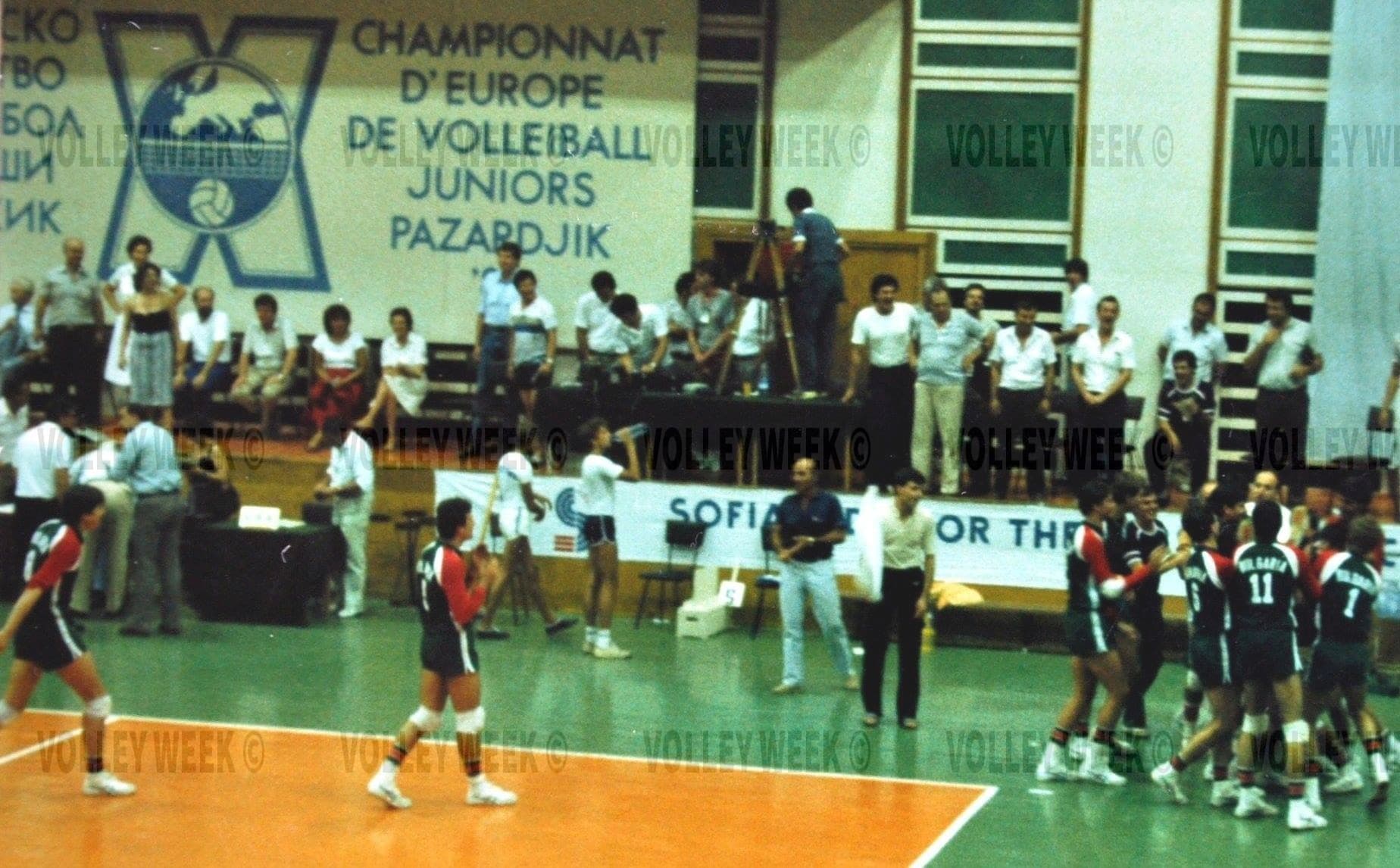
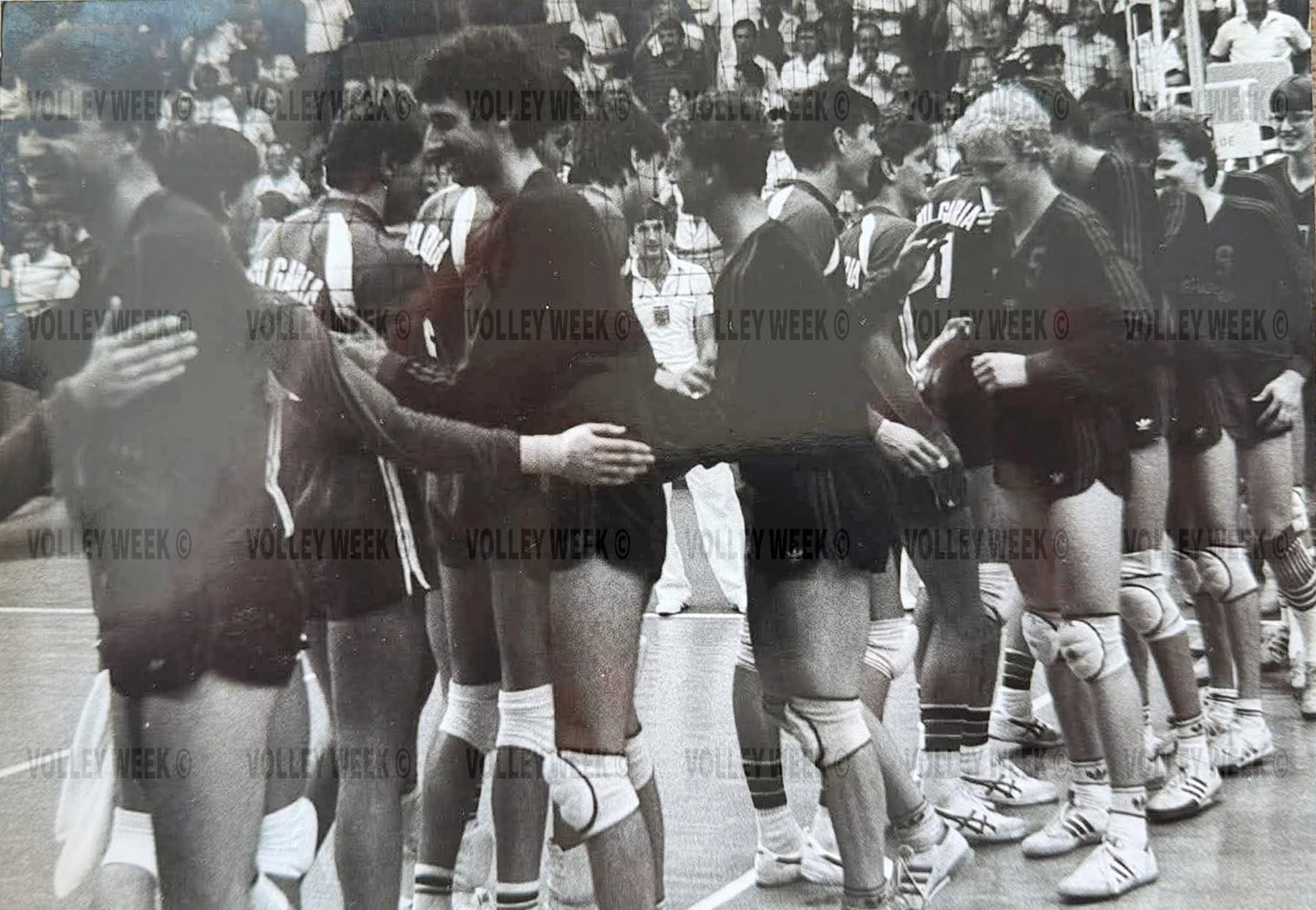
In the photo from the last seconds of the championship, we are still there. Dankinov has just scored the last point. Tasev is walking towards me. The boys are gathering around Brunko Iliev to throw him in the air. I am holding the towel. The towel was never thrown. These boys did not give up. We should not give up on their memory either.
photos: personal archive


