

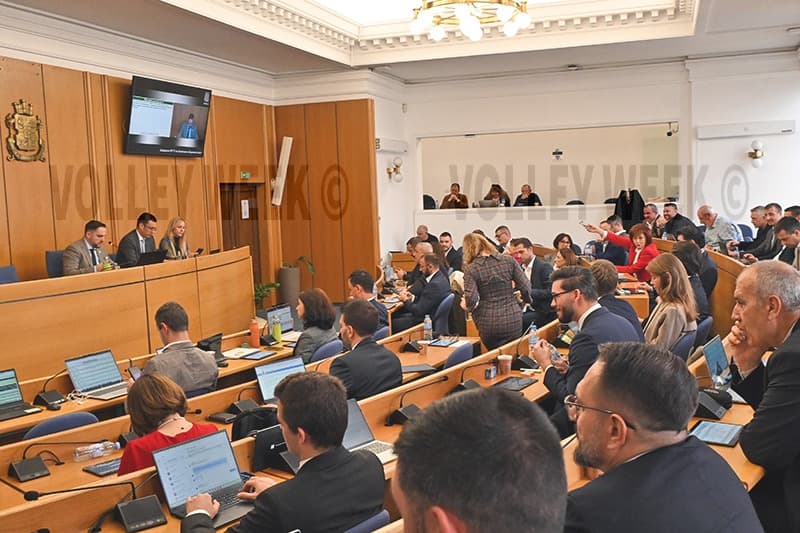
The Sofia Municipal Council (SMC) was just one vote short of approving the proposal to finance three international skateboarding competitions in Sofia in 2027, 2028, and 2029 with up to 9.6 million euros. At the meeting on November 5, the project received 30 votes "for" when 31 were needed and was rejected.
The proposal envisioned Sofia applying to the international federation World Skate for two Olympic qualifiers for Los Angeles 2028 and one World Cup competition in 2029.
Even before the vote, the project provoked sharp reactions among the leaders of Bulgarian sports. The main question they raised was not whether skateboarding deserved support, but whether such a financial commitment was justified given the problems with sports infrastructure and the funding of clubs in the capital.
Sports Federations: 9.6 million for three competitions, while clubs face higher rents
The Association of Bulgarian Sports Federations (ABSF) issued an official statement against the proposal, signed by its chairman Ivan Tsenov.
The organization insisted that the funds be directed primarily towards sports infrastructure and youth sports.
In the letter published in the media, the federations express indignation that millions are being allocated for international hosting, while clubs are struggling with the costs of training facilities.
The issue of the discussed changes in the conditions for using school sports halls is particularly acute. According to calculations by the sports community, they could lead to an almost fourfold increase in rents. This is an assessment of the possible effect of the proposed changes, not an already confirmed increase.
The Association points out that with such resources, sports halls could be built, access to school halls could be supported, and international competitions in sports such as volleyball, basketball, athletics, gymnastics, and taekwondo could be organized.
Georgi Pavlov: With this money, we can build four athletics tracks
The president of the Bulgarian Athletics Federation, Georgi Pavlov, was among the first to publicly challenge the proposal. In a Facebook post, he points out that in Sofia alone there are about 25 athletics clubs where nearly 2,500 children train. According to Pavlov, with 9.6 million euros, four projects for new athletics tracks could be realized – in Sofia, Plovdiv, Varna, and Burgas.
Pavlov also gives other examples of potential uses of the funds – development of the Sofia Marathon, attracting a Diamond League competition, and international championships in sports with established Bulgarian traditions.
In his statement, he also draws special attention to the European Men's Volleyball Championship in 2026, for which the Sofia Municipality provided 500,000 leva for hosting.
Pavlov emphasizes that he is not opposing individual sports but insists on clear criteria for spending public funds and an assessment of long-term benefits.
Aleksandar Popov: The capital does not pay enough attention to professional sports
The president of CSKA volleyball club, Aleksandar Popov, also expressed bewilderment at the size of the proposed funding. In a statement toSportal.bgon November 4, he points out that it is wonderful for Bulgaria to host international sports competitions, but attention should also be paid to professional clubs in Sofia.
Popov compares the situation in the capital with that in other cities. According to him, Stara Zagora Municipality provides the Ivan Vazov Hall for use by Beroe and covers the utilities for sports clubs, while Burgas Municipality has invested in the renovation of the Mladost Hall.
The head of CSKA describes the municipal support for professional clubs in Sofia as extremely limited compared to that in other cities. In his statement, Popov talks about an annual sports budget for Sofia of about 1 million euros. However, this amount does not cover all municipal sports expenditures.
Martin Milanov: How many children will use this money after the competitions end?
A similar position was taken by the president of the Bulgarian Ice Hockey Federation, Martin Milanov. In a social media post, he referred to his experience in organizing dozens of ice hockey world championships.
Milanov points out that he supports major international events but insists that before allocating such financial resources, a concrete calculation should be made of what sports facilities can be built or renovated with these funds.
According to him, Sofia needs more sports halls, ice rinks, and accessible school gyms. He also draws attention to the problems faced by coaches and parents in finding available hours and suitable training conditions.
126 sports clubs receive 1 million euros per year
The criticisms of sports leaders can be compared with official data on municipal funding. A statement from the Sofia Municipality on October 15 this year indicates that 126 sports clubs receive a total of 1 million euros for the development of their youth academies. Of these, 45 develop team sports, and 81 — individual sports.
The municipality also allocates 240,000 euros under the "Sofia Sports" program for 44 organizations and 1.21 million euros for the repair and maintenance of sports fields and facilities in the 24 metropolitan districts.
This means that the planned 9.6 million euros for the three skateboarding competitions are9.6 times more than the amount with which the municipality supports the youth academies of 126 sports clubs for one year.
The comparison is not between identical budget periods — the skateboarding proposal covers three years, while the funding for the academies is annual. However, it shows the scale of the financial commitment that the Sofia Municipal Council was ready to discuss.
The financial question: 9.6 million for rights or also for infrastructure?
The official report of the Sofia Municipality from October 29 states that a total fee of up to 9.6 million euros, or an average of 3.2 million euros per competition, is proposed for acquiring the hosting rights.
However, a different breakdown was presented during the discussion in the financial committee. According to "24 Chasa" from November 3, municipal councilor Dimitar Petrov explained that the fee to World Skate is about 2 million euros per competition. Additionally, about 1.2 million euros were mentioned for a temporary facility and television production, as well as an idea for a permanent skatepark in the Western Park.
Other public explanations also mention an indicative value of about 2.5 million euros for the permanent facility.
The sum of these approximate values reaches 9.7 million euros. The difference of 100,000 euros can be explained by rounding, but the more significant question remains whether the initially recorded 9.6 million euros are only for hosting rights or also cover the other expenses.
According to "Club Z", during the meeting on November 5, Dimitar Petrov proposed that all accompanying organizational costs and the construction of a permanent skatepark be included in the project. Without a final detailed financial breakdown, the total cost of the entire project cannot be definitively established.
The report also includes an example scenario for sponsorship revenues between 2.01 and 2.07 million euros for the three competitions. The authors explicitly state that these are not guaranteed revenues.
How the municipality defended the proposal
The project initiators justified the expense with the possibility for Sofia to become a recognizable destination for major international sports events.
As "Club Z" reports, Mayor Vasil Terziev defended the project before the municipal councilors, arguing that such hostings are primarily a means of international marketing for the capital.
Dimitar Petrov presented a projected economic effect of about 33 million euros and over 70,000 tourist overnight stays, according to the same report. In its publication after the meeting, however, "24 Chasa" cited a different amount – 45 million euros in direct and indirect benefits, as stated by Petrov.
In both cases, it is about a projected economic effect, not guaranteed revenues for the municipal budget.
Municipal councilors Ivan Takov and Proshko Proshkov also spoke in defense of the project, who, according to "Club Z," emphasized the potential for international events to increase interest in Sofia and bring long-term benefits for tourism.
Among the critics were Andrey Zografski and Boris Bonev from "Save Sofia." Zografski pointed to examples of skateparks built in other Bulgarian cities and presented his own assessment that nearly 10 million euros could build 36 similar facilities. Bonev stated that he would submit a proposal for the construction of five skateparks in Sofia.
For EuroVolley 2026, the municipality allocated 500,000 leva.
Against the backdrop of the debate, the comparison with the European Men's Volleyball Championship takes on particular significance. On October 9, 2025, the Sofia Municipal Council unanimously voted, with 54 votes "for," to allocate up to 500,000 leva for the preparation and organization of EuroVolley 2026 in Sofia.
It is important to note that these funds do not represent the entire cost of hosting the volleyball event. According to data reported by the president of the Bulgarian Volleyball Federation, Lyubomir Ganev, the rights for the championship cost 1.2 million euros, and the expenses for using "Arena Sofia" are over 500,000 euros.
Despite the differences between the two projects, the comparison provides grounds to raise the question of what criteria the municipality uses to determine its financial support for international sports hostings.
The voting ended, the questions remained.
The official video recording of the Sofia Municipal Council meeting on November 5 confirms that the proposal was rejected after two votes.
In the first vote, the result was 29 votes "for," 15 "against," and 6 "abstained." A total of 50 municipal councilors participated, and the remaining 11 did not vote or were absent.
In the repeat vote, the positive votes became 30, 16 were against, and 6 abstained. Thus, the number of voters increased from 50 to 52, but the support remained one vote short of the necessary majority of 31.
Immediately after the announcement of the final result, the Chairman of the Sofia Municipal Council, Tsvetomir Petrov, reacted sharply against the opponents of the proposal.
"Congratulations to all who managed to prevent Sofia from being a candidate for the biggest..." he stated, before directing his criticism towards "Save Sofia."
Petrov addressed the representatives of the formation with a question about how the funds, which he claimed they had promised to sports federations, would be distributed.
"Now, colleagues, I expect from you, from all those from the federations to whom you promised the money, to see how you will distribute it. And I will tell you what will happen. A big zero! A big zero! Everything that 'Save Sofia' promised – a big zero!" stated the Chairman of the Sofia Municipal Council immediately after the vote.
With its decision, the Sofia Municipal Council did not cancel an already agreed hosting, nor did it stop a payment that had been made. The proposal for Sofia to apply and undertake the corresponding financial commitment under the discussed conditions was rejected.
But the reactions of the leaders of athletics, volleyball, ice hockey, as well as the Association of Sports Federations, brought to the forefront a significantly broader problem.
Sofia must find a balance between investments in international sports events and funding for clubs and facilities that are used daily.
Because the question is not only how many spectators and tourists a competition can attract, but also what material base and what opportunities for sports will remain for the capital's children after its end.
photo: Nikolay Varadinov


