



While the best national teams in the world battle for honors at major international tournaments, one topic is gradually shifting attention away from what's happening on the court. It's not about tactical schemes, star performances, or sensational results, but about the new referee interpretations of ball contacts, which are causing increasing dissatisfaction among volleyball players.
In recent weeks, a number of leading players have openly expressed their concerns about how controversial situations are being called. Common to all opinions is a sense of inconsistency. Players do not dispute the need to follow the rules, but rather question why the same situation is sometimes allowed and other times leads to a foul call.
Among the most vocal critics is Italian international Mattia Bottolo, who stated that no one is sure anymore when an action is performed correctly and when it depends on the referee's individual judgment. His teammate Francesco Sani also drew attention to the problem, pointing out that identical contacts often receive different assessments even within the same match.
At the heart of the dispute are not so much the rules themselves, but their interpretation. The International Volleyball Federation has not significantly changed the regulations, but has placed a greater emphasis on the quality of ball contact, especially during finger play (setting). The goal is to limit held balls and double touches, which often go unnoticed at the high speed of the game.
In theory, this seems logical. Volleyball has always been a sport where technique is of key importance. In practice, however, the question arises whether such strictness is compatible with the modern style of play.
Today's volleyball is faster than ever. Setters make split-second decisions, attackers play increasingly complex schemes, and defenders are forced to save almost impossible balls. In such an environment, it is difficult for every contact to appear perfectly clean from a technical standpoint.
This is precisely why setters are most affected by the new interpretations. They are the players who most often handle the ball on the move, under pressure, and in unconventional situations. Any stricter judgment during finger play directly impacts their ability to organize the team's attack.
Bulgarian international Simeon Nikolov also found himself in a similar situation during the fourth match of the first tournament in Brazil against Serbia. With the score at 10:6 for Bulgaria in the third set, when the Serbs were already leading 2:0 in sets, the first referee, Alexander Sikanic from Liechtenstein, called a held ball on the young setter, which provoked strong reactions from the Bulgarian team.
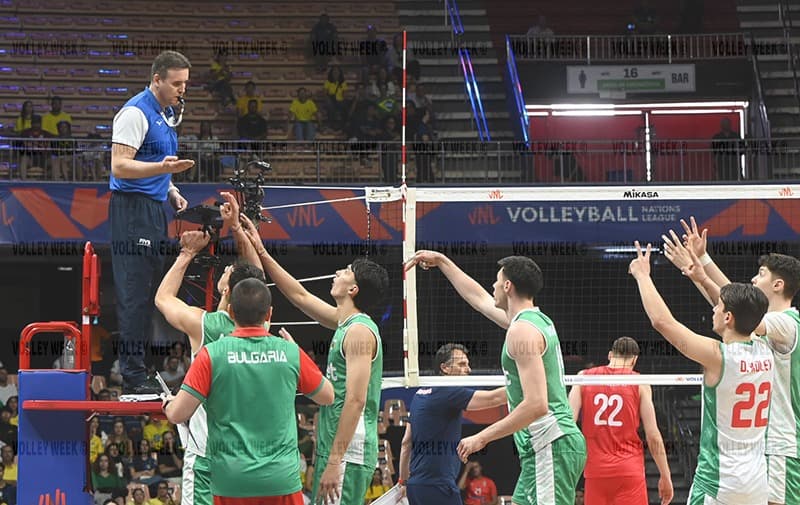
It is precisely in such moments that the essence of the current debate lies. When a team is trying to turn the tide of a match after being down 0:2 sets, every controversial call can affect not only the score but also the psychological momentum driving the game. Should the deficit be reduced and the team get back into the match, the outcome becomes significantly more unpredictable.
The controversial situation was not isolated. A little later, with the score at 16:14 for Bulgaria, Sikanic again called a carried ball on Nikolov. Instead of the Bulgarian team's lead increasing to three points at 17:14, the score became 16:15, and the tension in the match further increased.
Whether the decisions were correct according to the new guidelines is a matter of referee's judgment and subsequent video analysis. The very fact that such calls provoked immediate reactions both on the court and among experts and fans shows how sensitive the topic of new interpretations is and how important it is that they be applied in a clear and consistent manner.
Another serious issue is related to the consistency of calls. German international Erik Röhrs believes that referees are still looking for a common line of conduct. This is probably a natural process when introducing new guidelines, but it creates a sense of uncertainty among players. When volleyball players cannot predict how an action will be assessed, they start playing more cautiously, which inevitably affects the quality of the game.
Kamil Rychlicki was even more critical, according to whom the different interpretations are currently creating chaos. His statement may sound extreme, but it reflects the sentiments of a significant portion of players who expect clearer explanations and more unified criteria.
The paradox is that over the past two decades, FIVB has consistently worked to make volleyball a more spectacular sport. A more liberal treatment of the first touch and the pursuit of longer rallies were part of this policy. Now, however, some players believe that stricter interpretations could have the opposite effect and interrupt rallies that would otherwise continue.
Of course, there is also the other point of view. If the rules are not applied strictly, technical standards gradually become blurred. In this sense, the efforts of the refereeing committee can be seen as an attempt to preserve the purity of the game and prevent controversial contacts from becoming commonplace.
The truth probably lies somewhere in the middle. Volleyball players don't want fewer rules, but more predictability. Referees don't aim to be the center of attention, but find themselves under pressure to apply new criteria in real game situations. Until both sides reach a common understanding of what constitutes a regular ball contact, the debate will continue.
And this is hardly good news for the sport. Because the best volleyball has always been when, after the final ball, everyone talks about the players, not the referee's decisions.


