


The newcomer in Super Volley, Metalurg (Pernik), gets an opportunity even before playing its first official match in the Bulgarian elite – to open the door to European club tournaments.
The Pernik team is among the four participants in the Balkan Cup (BVA Cup) 2026, which will be held from October 17 to 19 in Kalamata, Greece. Besides the host Kalamata 80, Istanbul Genclik from Turkey and Luboteni (Ferizaj) from Kosovo will also participate.
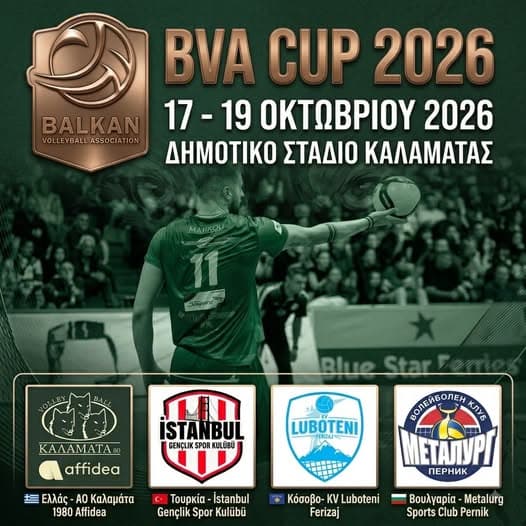
The stakes are high – the winner receives a quota for the CEV Challenge Cup 2026/27.
However, Metalurg's presence is curious. How did a club that didn't even play in Super Volley during the 2025/26 season get the opportunity to represent Bulgaria in the Balkan Cup?
Just a few months ago, Metalurg was part of the Higher League. The Pernik team finished second after Dobrudzha 07, and then lost the playoff for a place in the elite to Dunav with 0:3 (21:25, 21:25, 16:25).
Later, Dobrudzha withdrew from participation in Super Volley, and Metalurg received an invitation to take the vacant spot. Thus, the Pernik team will be a newcomer in the elite during the 2026/27 season.
Now, an international opportunity also opens up for them.
According to the regulations of the Balkan Volleyball Association, each national federation can nominate one men's and one women's team for the Balkan Cup. This right is reserved for the highest-ranked club that does not participate in CEV European tournaments, wishes to play in the BVA Cup, and is ready, upon winning it, to proceed to the Challenge Cup, assuming the corresponding financial obligations.
This is precisely where Metalurg's case becomes interesting. The Pernik team cannot be the highest-ranked Bulgarian club outside of European tournaments based on the 2025/26 results, because they were not even part of Super Volley that season.
Bulgaria already has four representatives in CEV tournaments – Levski Sofia in the Champions League, Neftochimic 2010 in the CEV Cup, and Lokomotiv Avia and CSKA in the Challenge Cup.
The first of the remaining clubs according to the final standings is Beroe 2016. And it is precisely with the Stara Zagora team that we already know why they will not participate.
On June 5, Beroe's president, Zhivko Zhelev, stated to Zara Sport that he wished Stara Zagora would even apply to host the Balkan Cup.
"It entirely depends on me whether we will participate in European club tournaments this summer. I would like Stara Zagora to apply to host the Balkan Cup tournament. This would be good publicity for the city," Zhelev said then to Zara Sport.
A little over a month later, the situation changed. On July 16, Zhelev spoke again to Zara Sport and now announced Beroe's withdrawal. The reason is mainly related to the problems surrounding the final completion of the squad.
Visa difficulties prevent the planned new signing, Iranian Amir, from obtaining the right to work in Bulgaria, the squad is significantly rejuvenated, and future captain Rangel Vitekov is recovering from an injury.
"This may force us to look for his replacement and is the main reason for us to withdraw from participating in the summer club tournament, the Balkan Cup. In terms of personnel, our team is significantly rejuvenated. There is no point in participating in a competition just for the sake of the Olympic principle and without the thought of winning it," Zhelev explained to Zara Sport.
Thus, at least for Beroe, the question mark is removed. The Stara Zagora team initially even wanted to host the tournament, but subsequently withdrew for sports and technical reasons.
Zhelev confirmed Beroe's withdrawal to our media and also commented on the curious question of how the opportunity ultimately reached Metalurg.
According to him, most likely the other clubs also did not wish to participate, with the financial factor probably being one of the main reasons.
This does not mean that we have a confirmed refusal from every club individually. But such an explanation has its economic logic.
The Balkan Cup brings prestige and opportunities for international matches, but also costs. And winning it means a subsequent financial commitment – participation in the Challenge Cup. For a Bulgarian club with a limited budget, the calculation is not always attractive, especially given the relatively limited direct revenues in the third strongest European club tournament.
For Metalurg, the situation might look different.
Pernik is just entering Super Volley, and international participation at the beginning of the project could be a serious investment in the club's image – both for the public in Pernik and for potential partners and sponsors.
There is also a purely practical factor. The tournament is in Kalamata, which makes logistics relatively acceptable for a Bulgarian club. For these costs, Metalurg gets the opportunity to reach a European quota within just one tournament.
Beroe already took a similar path. In 2024, the team from Stara Zagora reached the final of the Balkan Cup in Thessaloniki, but lost to the Turkish Arcas Izmir with 0:3 (22:25, 15:25, 18:25). Arcas won the trophy and with it the quota for the Challenge Cup.
Thus, an unusual opportunity emerges for Metalurg. Just a few months ago, the club was playing in the Higher League and lost the playoff for Super Volley. After Dobrudzha's withdrawal, it got a place in the elite, and now it will represent Bulgaria in the Balkan Cup.
And if they win in Kalamata, the Super Volley newcomer could go all the way from the Higher League to European club tournaments in just a few months.


