



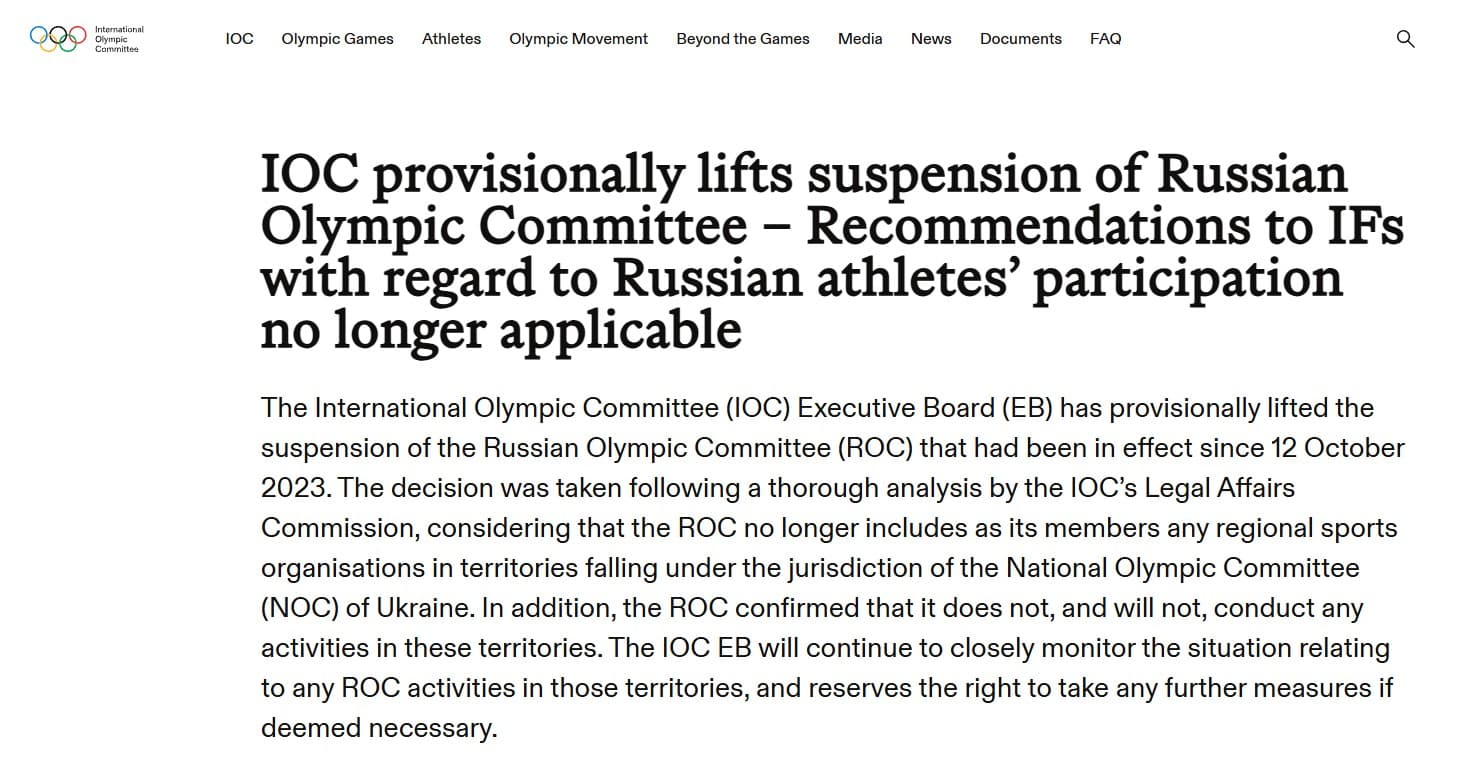
The International Olympic Committee (IOC) conditionally lifted the suspension of the Russian Olympic Committee (ROC), imposed on October 12, 2023. The decision by the IOC Executive Board follows a thorough analysis by the organization's Legal Commission, which found that the ROC no longer includes in its structure regional sports organizations from territories under the jurisdiction of the National Olympic Committee of Ukraine. The ROC, for its part, confirmed that it does not and will not conduct activities in these territories, and the IOC clarified that it will closely monitor the situation and reserves the right to take new measures if necessary.
Along with the suspension, the recommended conditions for the participation of Russian athletes and teams are also dropped, including the protective measures introduced earlier.
The IOC, however, set clear frameworks for their potential return:
All Russian athletes must comply with current anti-doping requirements.
The IOC will not organize its events in Russia, nor will it invite Russian state or government representatives to its events.
The question of using the Russian flag, anthem, national colors, or other state identification at the Olympic Games remains open and will be addressed "at an appropriate time."
The IOC emphasized that it continues to support the Olympic community of Ukraine.
What does this mean for volleyball?
For now – almost nothing new. Unlike the IOC, the International Volleyball Federation (FIVB) follows its own, stricter policy, which does not automatically change after every decision by the Olympic Committee. The ban, introduced in March 2022, remains in effect, and Russian, as well as Belarusian national teams, clubs, officials, and athletes in volleyball, beach volleyball, and snow volleyball continue to be prohibited from participating in international and continental tournaments.
The only significant relief so far is aimed at junior athletes. From January 1, 2026, the FIVB allowed junior and youth national teams of Russia and Belarus to participate in international age-group tournaments under the federation's standard protocol, including with their own flag and anthem. The FIVB then explicitly emphasized that this decision applies only to juniors and does not revoke sanctions against men's and women's senior national teams.
The first sign of a certain thawing in relations appeared as early as spring 2025, when friendly matches were held in Belgrade between the national teams of Serbia, Russia, and Belarus. These were the first such matches for the representative teams after nearly four years of international isolation.
What the Russian side says
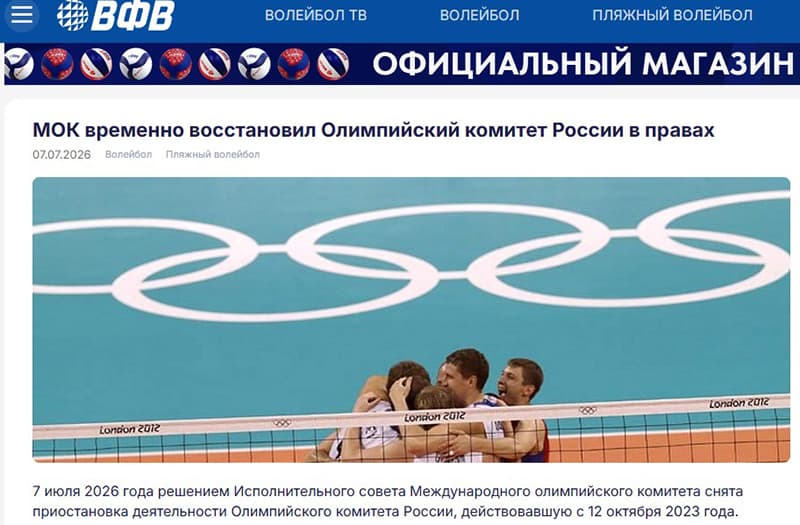
The All-Russian Volleyball Federation (RVF) reacted to the IOC's decision with an official publication recounting the Olympic Committee's announcement, including the lifting of recommended restrictions from February 2022 and March 2023. The Federation further noted that until RUSADA is reinstated, Russian athletes will continue to be temporarily tested by the International Testing Agency (ITA). The material emphasizes that decisions regarding the return of individual sports now depend on the respective international federations, with the RVF reiterating that Russian volleyball is ready to return at any moment.
An important clarification is that the RVF's official position is significantly more cautious than the publications circulating on social media. Claims appeared online that the federation had already announced a "great success" and an imminent immediate return to the FIVB world rankings, but no such statement is present in the official text. It only speaks of readiness to return, not of a decision already achieved.
What's next
At this stage, the IOC's decision does not oblige the FIVB to take any action. The International Volleyball Federation has already shown that it makes independent decisions, although it usually adheres to the general direction of the Olympic movement. If the IOC proceeds towards full normalization of Russia's status, pressure on the FIVB to review sanctions for senior national teams may increase. For now, however, there are no official indications from the world volleyball headquarters that such a change is imminent.


